Weblog

LOD & London Online Conference

Last week I defied snow and Eurostar delays to visit the London Online Conference. The conference exists already a couple of years. It brings together publishers, technology provides, content aggregators, … I did what I name “a reverse conference”. This means that I try to “sell” something to some of the booths. I approached some governmental organizations to explain them briefly that their world is changing, again. Instead of having a web of documents we will be faced with a web of data. I explained them that the LOD2 project had a FREE service through which they could come to a better understanding of this web of data.

Below are some of the organizations that were interested.

The good news was that people in the booth were interested in this new format for publishing. Most of the time they understood what I was talking about and they wanted to take the matter further. I also explained them the LOD2 PUBLINK service.  This service helps them to understand the value of Linked Open Data for their organization.

Of course I visited the booth of the European Commission. There I found the Publications Office and DG EMPLOYMENT. Let me tell you that both these organization within the EC understand the value and opportunities of Linked Open Data as way to make their data more reusable and machine readable. For the vision on semantic technology of the Publications Office have a look at the recent Eurovoc Conference, Mind the Lexical Gap.

Posted in Events, Publink, WP9 – LOD2 for Citizen – PublicData.eu

Paneuropean Open Government Data Survey – join now!

LOD2 project is currently circulating a survey aimed at people interested in open government data. If you are interested in government information (whether as a publisher, producer, reuser or consumer) LOD2 – team would be very grateful for 10-15 minutes of your time to let them know about what you would like to see from the technology developed by LOD2.

You can find the survey at survey.lod2.eu

The survey will be open until the 17th December 2010.


Very much appreciated, is any help in forwarding this to relevant colleagues or suggestions for people this should be  to, and for any blogging/tweeting to make sure as many potentially interested people as possible have the opportunity to respond! If you have any questions or issues about the survey please don’t hesitate to contact Martin Kaltenböck <m.kaltenboeck –at– semantic-web.at> or Thomas Thurner <t.thurner–at– semantic-web.at>.

Posted in WP9 – LOD2 for Citizen – PublicData.eu | Tagged , , , , , ,

Linked Data for eGovernment – A Tutorial Session at ISWC2010

Monday, November 8th, Shanghai, ISWC2010:
A tutorial on Linked Data for eGovernment jointly sponsored
by the ‘Creating Knowledge out of Interlinked Data’ (LOD2) project.


Thanks to high-profile initiatives in the U.S. and UK, the government domain has emerged as the most promising and dynamic application area for Semantic Web technologies. With this tutorial we give an overview on the landscape of existing governmental data activities, share experience on organisational and policy issues concerning governmental data, and show how a number of eGovernment specific use cases can be addressed using Linked Data technologies. This tutorial equips 2010 with the necessary knowledge, and it raises awareness of the technical and the non-technical issues involved.

Programme

  1. Invited speaker: Prof. Jim Hendler on ‘Raw Government Data Now!’
  2. The Linked Government Data Landscape Today
    1. data.gov.uk
    2. data.gov and the data-gov project at RPI
    3. W3C activities
  3. Linked Data 101
    1. URIs – Global Identifiers
    2. RDF and the Web
    3. The role of vocabularies
  4. Lessons learned on organisational and policy issues
  5. Specific technologies
    1. Making government data discoverable with dcat and voiD
    2. Publishing official statistics with SDMX-RDF
    3. Reaching the citizen developer: the Linked Data API
    4. Creating compelling visualisations and demos
  6. Invited speaker: Sandro Hawke (W3C)

Organiser

Michael Hausenblas (http://sw-app.org/about.html) is a postdoctoral researcher at DERI and the co-ordinator of the Linked Data Research Centre. He has been involved in several international research projects since 2001, and has contributed to the Web of Linked Data in various domains: from the RDFa standardisation, over the creation of the voiD vocabulary and Dataset Dynamics, to chairing the W3C RDB2DF Working Group. He gave tutorials on Linked Data applications at the World Wide Web Conference 2009, and on RDFa as well as on Linked Data at the International Semantic Web Conference 2008.

Li Ding (http://www.cs.rpi.edu/~dingl/) is a research scientist in the Tetherless World Constellation at Rensselaer Polytechnic Institute (RPI). He is the technical leader of the Data-gov project at RPI, which is generating Linked Government Data from US data.gov data and publishes many mashups and demos that make use of Linked Government Data. He is also known as the founder of Swoogle, one of the first semantic web search engines on the Web. He is an active researcher in the Semantic Web community and has served as organizer and program committee member for major conferences such as WWW, ISWC and CIKM, and many other international workshops.

Rob Styles (http://dynamicorange.com/) is an Internet technologist working for Software and Semantic Web company Talis. As Programme Manager, Data Services, Rob has been working for Talis since 2004, focusing on the large databases that Talis has been involved with for more than 30 years, Talis Base best known amongst them. Rob also has a keen interest in intellectual property law, helping Talis with its work on the Open Data Commons licenses. Prior to working at Talis Rob was involved in the successful internet bank, Egg and with other award-winning financial services sites. Rob holds a Bachelor of Science in Computer Science from the University of Hull. He has extensive experience in outreach and evangelisation concerning Linked Data in the governmental domain and gave several tutorials in this area.

Richard Cyganiak (http://richard.cyganiak.de/) is a researcher at DERI’s Linked Data Research Centre. He is a co-founder of the Linking Open Data initiative, chair of the Data Catalog Vocabulary (dcat) project in the W3C’s eGovernment Interest Group, contributor to the SDMX-RDF proposed standard for publishing official statistics as Linked Data, and creator of a number of Linked Data related software projects. Richard is a fellow of the Web Science Research Initiative. He has presented tutorials on Linked Data at ISWC 2008 and the Web of Data Practitioners Day 2009, and has co-authored the tutorial-style documents How to Publish Linked Data on the Web and Cool URIs for the Semantic Web.

John L. Sheridan (http://twitter.com/johnlsheridan) is Head of e-Services and Strategy at the Office of Public Sector Information (OPSI) in addition to serving as a co-chair of the W3C’s eGovernment Interest Group. OPSI is a key enabler for the re-use of government information in the UK, with responsibility for the re-use strand of policy development and the operational management of Crown copyright and database rights. John works at the intersection of information policy, technology and online service delivery. With a background in IT, specializing in the Web, he has led a number of projects to enable government data, in particular using Semantic Web technology. John has spoken at numerous conferences and events, in the UK and internationally, speaking to both policy and technology audiences.

Source: latc-project.eu

Posted in Events | Tagged , , , ,

LOD2 project organises Linked (Enterprise) Data Track @ ESTC2010

The 4th European Semantic Technology Conference 2010 (ESTC 2010) will take place in Vienna, Austria from 2nd to 3rd of December 2010. The STI International asked the LOD2 project consortium to organise a Linked (Enterprise) Data track / workshop on this years conference.

Although it is still very early in the LOD2 project lifetime (as we have kicked off the project in early September) the LOD2 team is happy to organise this track – we have bundled together an interesting series of presentations and talks for the ESTC2010 as follows:
Linked (Enterprise) Data Track
organised by LOD2 project (http://lod2.eu)
ESTC2010 – 02.12.2010, 10.30am to 12.30pm

For detail information on the track as well as on the above mentioned 4 presentations/talks please visit the respective ESTC programme page.

We are looking forward to meeting all interested people @ the ESTC2010 in Vienna – so save the date and register now!

Btw there is a Semantic Web meetup Vienna on the 1st December 2010 in the evening – so if you are in Vienna this evening – register for free & join us!

Posted in Events | Tagged , , , , , , , , , ,

The Science in LOD2

The Linked Data principle is a very simple best practice for publishing and interlinking data on the Web. You might now ask, so what is the LOD2 project all about. Do they perform any research? In fact, although the LOD principles are so simple, the publishing of large amounts of data on the Web reveals a number of research challenges. On the other hand the Web of Linked Data is also a perfect test-bed to showcase the practicability and efficiency of scientific approaches. In this post we briefly outline the main research objectives of LOD2:

1. Improving the performance of very large-scale RDF Data Management. Experience demonstrates that an RDF database can be an order of magnitude less efficient than a relational representation running on the same engine. This lack of efficiency is perceived as the main obstacle for a large-scale deployment of semantic technologies in corporate applications or for expressive Data Web search. For RDF to be the lingua franca of data integration, which is its birthright, its use must not bring significant performance penalty over the much less flexible best practices prevalent today. We, therefore, intend to overcome the performance gap between relational and RDF data management by developing adaptive automatic data indexing technologies that create and exploit indexing structures as and when needed, entirely based on received query workload. We will make sure such new RDF indexing technology finds its way in RDF processing systems, directly through participation in the project, as well as by publishing these technologies openly, and also by making them available in open-source systems such as Virtuoso and MonetDB.

2. Increase and ease the interlinking and fusion of information. While the sum of data published as linked data amounts already to billions and grows steadily, the number of links between them is several orders of magnitude smaller and by far more difficult to maintain. In LOD2 we cope with this problem by integrating schema mapping and data interlinking algorithms into a mutual refinement cycle, where results on either side (schema and data) help to improve mapping and interlinking on the other side. We will investigate, both unsupervised and supervised machine learning techniques for this task, where the latter enable knowledge base maintainers to produce high quality mappings. Mappings will be contributed by the project for well-known published data sets. In addition, further research is needed in the area of data fusion, i.e. the process of integrating multiple data items, representing the same real-world object into a single, consistent, and clean representation. The main challenge in data fusion is the reliable resolution of data conflicts, i.e. choosing a value in situations where multiple sources provide different values for the same property of an object.

3. Improving the structure, semantic richness and quality of Linked Data. Many data sets on the current Data Web lack structure as well as rich knowledge representation and contain defects as well as inconsistencies. Hence, methods for learning of ontology concept definitions from instance data have to be investigated in order to facilitate the easy incremental and self-organizing creation and maintenance of semantically rich LOD2 knowledge bases. Existing machine learning algorithms have to be extended from basic Description Logics such as ALC to expressive ones such as SROIQ(D) serving as the basis of OWL 2. The algorithms have to be optimized for processing very large-scale knowledge bases. In addition, we will pursue the development of tools and algorithms user friendly knowledge base maintenance and repair, which allow to detect and fix inconsistencies and modelling errors.

4. User interfaces and interaction paradigms. All the different Data Web aspects heavily rely on end-user interaction: We have to empower users to formulate expressive queries for exploiting the rich structure of Linked Data. They have to be engaged in authoring and maintaining knowledge derived from heterogeneous and dispersed sources on the Data Web. For interlinking and fusing as well as for the classification, structure and quality improvements, end users have to be enabled to effortlessly give feedback on the automatically obtained suggestions. Last but not least, user interaction has to preserve privacy, ensure provenance and, particularly in corporate environments, be regulated using access control.

In LOD2 we plan to tackle these challenges not in isolation, but by investigating methods which facilitate a mutual fertilization of approaches developed to solve these challenges. Examples include the following:

  • The detection of mappings on the schema level, for example, will directly affect instance level matching and vice versa.
  • Ontology schema mismatches between knowledge bases can be compensated for by learning which concepts of one are equivalent to which concepts of the other knowledge base.
  • Feedback and input from end users can be taken as training input (i.e. as positive or negative examples) for the machine learning techniques in order to perform inductive reasoning on larger knowledge bases, whose results can again be assessed by end users for iterative refinement.
  • Semantically enriched knowledge bases improve the detection of inconsistencies and modelling problems, which in turn results in benefits for interlinking, fusion, and classification.
  • The querying performance of the RDF data management directly affects all other components and the nature of queries issued by the components affects the RDF data management.

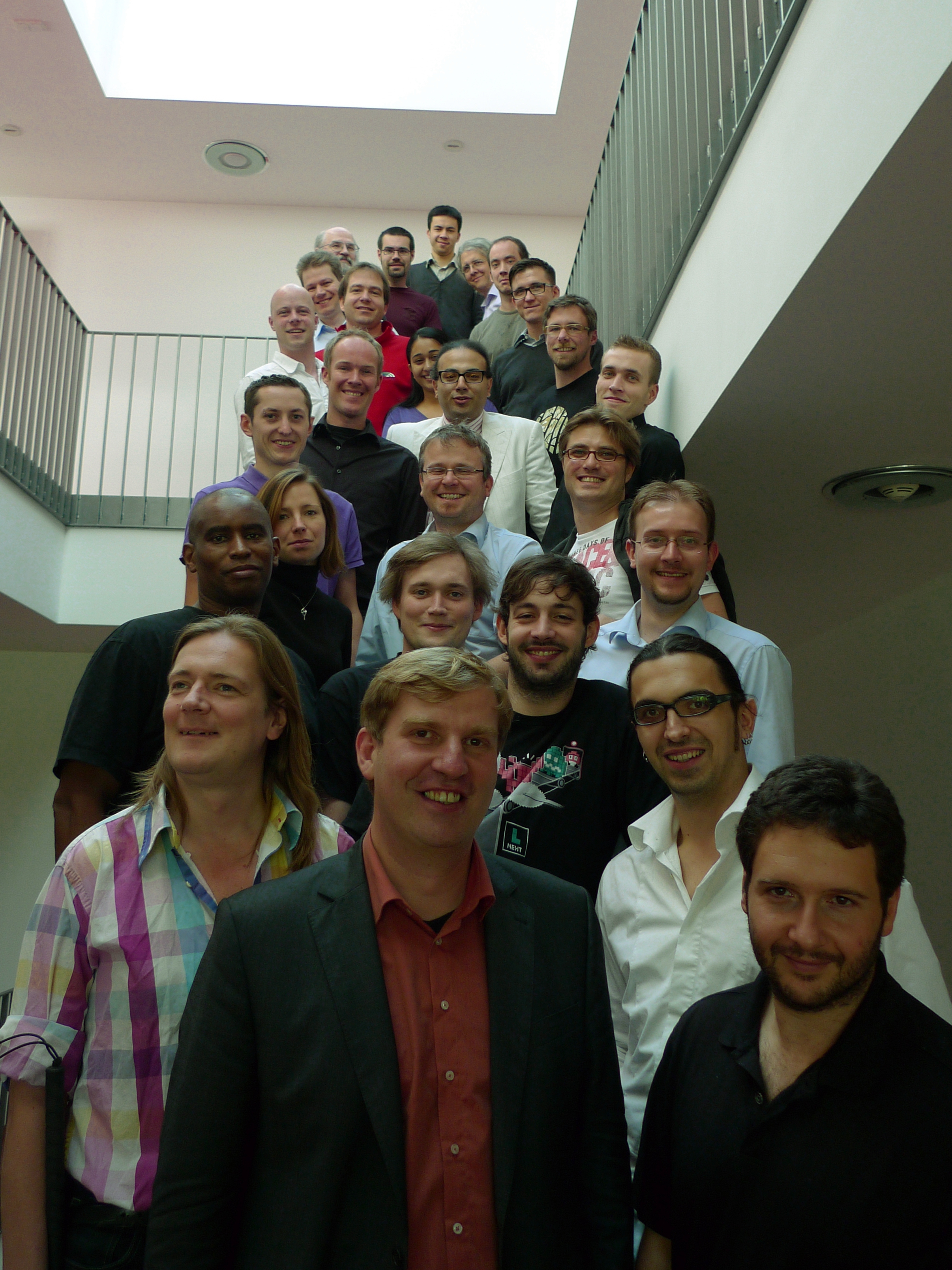
As a result of such interdependence, we intend to realize an improvement cycle for LOD2 knowledge bases (as depicted in the figure), in which an improvement of a knowledge base with regard to one aspect (e.g. a new alignment with another interlinking hub) triggers a number of possible further improvements (e.g. additional instance matches).

Posted in Misc

Wolters Kluwer Deutschland searches for Junior Content Architect

The Germany branch of the international publisher Wolters Kluwer is looking for support in the Content Architecture Team in Munich.

The new position will mainly work on the FP7-ICT LOD2 project, but also on other internal and international content projects.

A background in Information and/or Computer Science, familiarity with Web 2.0 and Semantic Data Web technologies as well as proper German and English language skills are mandatory.

For further information please have a look at the job offer profile in German language.

Posted in Job offers, WP7 – LOD2 for Media and Publishing

LOD2 members work on integrating Linked Data in the Future Internet Architecture

There is currently a intensive debate about the Future Internet Architecture. Many different communities develop specific parts of infrastructure, which at one point of time need to be able to interoperate. Unfortunately, currently the Future Internet architecture does not include means to achieve interoperability at a
data level. The Linked Data paradigm is a perfect candidate for achieving this interoperability.

Stefan Decker and Sören Auer from LOD2 consortium members DERI and Uni Leipzig are organizing a track on “Linked Data in the Future Internet” at the Future Internet Assembly (FIA), in Ghent on 16 December 2010. Aim of the track is to explain the linked data principles to the Future Internet stakeholders and to bring researchers, practitioners and industry interested in the topic together in order to develop concepts for exploiting Linked Data as a layer for data integration between different Future Internet applications.

More information can be found at:

Posted in Events

LOD2 launches PUBLINK the free Linked Open Data Consultancy offer for Data Owners

PUBLINK is the Linked Open Data Consultancy backed by the consortia of the EU-FP7 LOD2 (Integrated Project) and LATC (Support Action) projects. In order to lower the entrance barrier for potential data publishers the LOD2 and LATC consortia offer the free PUBLINK Linked Open Data Consultancy to up to 5 selected organizations supporting them with the publishing of Linked Open Data with an overall effort of 10-20 days of support from highly skilled Linked Data professionals.

More information can be found at: http://lod2.eu/Article/Publink.html

Posted in Publink

LOD2 co-organizes networking session on Open Governmental Data at ICT2010

The biennial event ICT conference has become a unique gathering point for researchers, business people, investors, and high level policy makers in the field of digital innovation. ICT 2010 will focus on policy priorities such as Europe’s Digital Agenda and the 2011-2012 financial programme (€2.8 billion) of the European Union for funding research and innovation in ICT.

Together OKFN’s group on Open Public Data, LOD2 co-organizes a networking session on Open Governmental Data at ICT2010. The session will discuss how public access to government data – crucial for an open and transparent society – can be improved.

The session has been proposed by IT professionals, scientists and government representatives organised – under the auspices of the Open Knowledge Foundation – as the Working Group on EU Open Data. It aims to establish a forum for networking and exchanging ideas with regard to publishing and linking governmental data, identifying technological developments and showcasing successful cases of linked governmental data. Developments in linked data could help further integrate information published by regional, national and European public administrations.

More information can be found at:

Posted in Events

Press Release: LOD2 Project Launch

New Technology Consortium Set To Change The Web As We Know It!

EU, Researchers, and Industry Leaders Seek to Transform Web of Linked Open Data into a Coherent Global Knowledge Space

LOD2 (Linked Open Data) is an EU co-funded project comprised of leading Linked Open Data technology researchers, companies, and service providers from across 7 European countries. Leveraging initial success across the Linked Open Data realm, the project is tasked with developing additional technology infrastructure and services that address new frontier challenges across government and industry.

LOD2 is 4-year collaborative research and development project, coordinated by the AKSW research group at Universität Leipzig that commences in September 2010. Consortium partners include: Centrum Wiskunde & Informatica (Netherlands); National University of Ireland, Galway; Freie Universität Berlin; OpenLink Software (United Kingdom); Semantic Web Company (Austria); TenForce (Belgium); Exalead (France); Wolters Kluwer (Germany); and the Open Knowledge Foundation.

Expected project deliverables include:

  • enterprise-ready tools and methodologies generating and publishing Linked Data on a massive scale to the burgeoning Web of Linked Data.
  • a testbed and bootstrap network of high-quality, multi-domain, multi-lingual ontologies derived from sources such as Wikipedia and OpenStreetMap.
  • algorithms based on machine learning for automatically interlinking and meshing disparate data across the World Wide Web.
  • standards and methods for reliably tracking provenance, ensuring privacy, data security, and other vital data and information oriented quality of service factors.
  • adaptive tools for searching, browsing, and authoring of Linked Data.

Situation Analysis

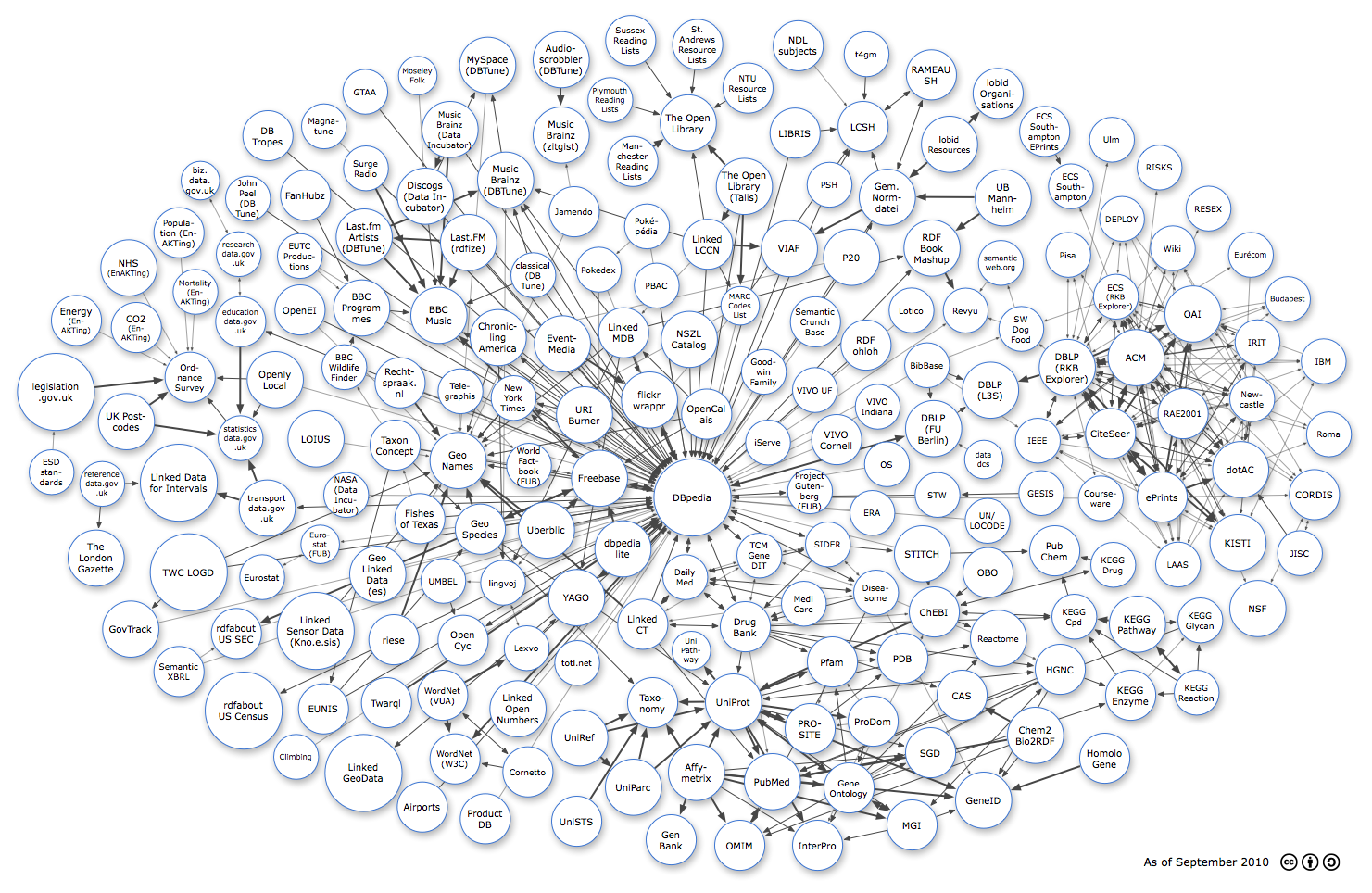
In recent times, Linked Data has emerged as a paradigm for integrating and publishing structured data on the Web. Driven by grassroots community effort, with laser-like focus on the generation of Linked Data from heterogeneous and disparately located data sources, we now have a viable Web of Linked Data comprised of more than 20 billion facts culled from sources such as: Wikipedia (via DBpedia), BBC programming, MusicBrainz, Eurostat, Healthcare and Life Sciences, Data.Gov, Data.Gov.UK, and many others.

In addition to the public data oriented Linked Open Data cloud, there is a wealth of data within enterprise intranets that would also benefit immensely from Linked Data publishing and integration. The same applies to internal and external data meshes across extranets.

However, generation of Linked Data is really the beginning of a process that seeks to alleviate the potential for data and information overload. Organizations that embrace Linked Data ultimately seek to produce actionable knowledge that provides foundation for attaining agility levels critical for information age success. Thus, LOD2 is oriented towards development of infrastructure technology and best practices that fill the chasm between structured-linked-data and applied  model logic & reasoning, en route to redefining the Web as we know it.

Partner Quotes

“LOD2″ states the project coordinator, Dr. Sören Auer, “is highly relevant for researchers, industry and citizens alike. Whether it is about the efficient integration of enterprise data, the open-standardized access to scientific publications and experiment data, or the opening of governmental data silos for the creative use by citizens, LOD2 will make significant contributions to evolving the Web into a coherent knowledge space.”

“Three years ago, we enthusiastically contributed the prowess of Virtuoso to the grassroots effort that lead to DBpedia and the Linked Open Data cloud that coalesced around it,” said Kingsley Idehen, President & CEO, OpenLink Software. “Today, we are both honored and enthusiastic about Virtuoso’s critical infrastructure role in this next generation LOD2 effort — focused on the challenges of BigData Integration, Change Sensitivity, Performance, and Scalability. LOD2 is going to go a long way towards materialization of the true potential and ultimate destiny of the World Wide Web,” he added.

“Linked (Open) Data technologies offer a new way of data integration for the enterprise! Smooth interoperability between internal data sets can reduce costs as well as  the enrichment of these data sets by external data can support new  market intelligence paradigms for a better decision making.” said Martin Kaltenböck (Semantic Web Company, CFO)

“Semantic  Markups on the Web could drive information reuse to enable scenarios  and applications which we can now only dream of. The idea is extraordinarely compelling, but we know now it won’t simply realize itself. The LOD2 project is now a great opportunity for inspired and coordinated research: to crack this nut, to ultimately change the world.” said Dr. Giovanni Tummarello (DERI NUIG, Research Unit Leader)

“The publishing of ever more datasets by e.g. governments adds value for  many key applications including business intelligence, which will drive  the Linked Open Data (LOD) paradigm going forward. In the LOD2 project,  CWI is working to increase the scalability and performance of querying  interlinked datasets, in the context of its open-source analytical  engine MonetDB.” said Dr. Peter Boncz (CWI)

“Linked (Open) Data will change the existing publishing paradigms! Creating high quality content for professional usage will remain an important factor in future publishing, but additional access points and new usage environments will equally define its success.” said Christian Dirschl (Wolters Kluwer Deutschland GmbH, Content Architect)

“An internet of data opens up  tremendous opportunities for our corporate and government customers. We  intend to be on the forefront of this evolution” said Bastiaan Deblieck (TenForce  partner and business development manager)

“Enterpise search is all about providing correct, complete, and appropriate information to the employee and  decision maker. LOD2 promises to not only allow internal company information to be linked up to the growing amount of Open Data on the web, but to also provide the mechanisms for validating the source of  this data, providing surer value to the enterprise.” said Gregory Grefenstette (Exalead, Chief Science Officer)

Special Offers

The free PUBLINK Linked Open Data Consultancy is immediately available to all organizations that own large data-sets of public interest, seeking to inject these data-sets into the burgeoning Web of Linked Data. The application deadline for this offer is 15th of December 2010. Further information about PUBLINK is available from the LOD2 website, <http://lod2.eu/Article/Publink.html>.

Additional Information Sources

A German version of this press release is available here: Press Release LOD2-Kickoff in German.

Contact details
  • Scientific Project Leader — Dr. Sören Auer, Phone +49 341 97-32367, Fax +49 341 97-32329, Email auer@uni-leipzig.de
  • Project Manager — Nadine Jänicke, Phone +49 341 97-32310, Fax +49 341 97-32329, Email jaenicke@uni-leipzig.de
Address

Universität Leipzig, Fakultät für Mathematik und Informatik, Institut für Informatik, Abt. Betriebliche Informationssysteme, z. Hd. Nadine Jänicke, Johannisgasse 26, 04103 Leipzig

Website
Pictures

Posted in Press releases


Public Mailinglist & Newsletter

Please subscribe me to the LOD2 mailinglist.
my email address
my name (optional)
goto archive

Follow


Follow lod2project on Twitter

RSS Twitter

  • mfhepp (martin hepp)
    the original #goodrelations rejection letter from #eswc2008 : http://bit.ly/mbHb6S #semanticweb #linkeddata #rdfa […]
  • jindrichmynarz (Jindřich Mynarz)
    Statistical #linkeddata in Data Cube covering Italian immigration. http://t.co/RVUVDPH /via @lod_it […]
  • mario_mh (Mario Meir-Huber)
    RT @john_avery: #bigdata #graphdb #semantic #linkeddata Temporal Graphs & Cray Hardware http://bit.ly/jGNKaJ […]

Events Map

iCal | RSS | JSON | KML