SemMF

SemMF

SemMF is a flexible framework for calculating semantic similarity between objects that are represented as arbitrary RDF graphs. The framework allows taxonomic and non-taxonomic concept matching techniques to be applied to selected object properties. Moreover, new concept matchers are easily integrated into SemMF by implementing a simple interface, thus making it applicable in a wide range of different use case scenarios.

Framework Architecture: he Matching Engine takes as input a query object and a collection of resource objects to be matched against the query object. Both are represented in RDF and may utilize different schema vocabularies. If they use concepts from a common taxonomy, an RDFS or OWL representation of this taxonomy has to be provided.

SemMF Engine is implemented in Java utilizing Jena2 Semantic Web Framework for accessing and querying of resource and query graphs as well as the underlying taxonomies.
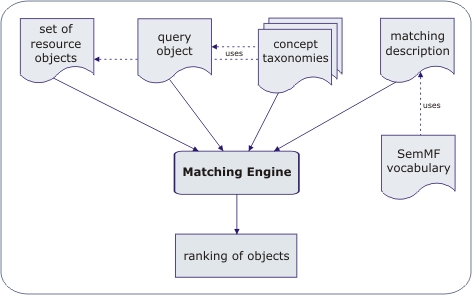
Matching Description: In most cases not every object property is relevant for the similarity computation. For example, an object representing a certain product may contain manufacturer's phone number which may be irrelevant for comparing product's characteristics with customer's preferences (query object). Thus, each relevant property in the query RDF graph must be explicitly specified and mapped to the semantically corresponding property (i.e. holding the same kind of information, e.g. price information) in a resource RDF graph. Each mapping is assigned a concept matcher implementing a certain matching technique.

In a matching description the importance of each object property can be specified by assigning it a certain weight . Moreover, properties to be matched can be grouped into thematic clusters, for example all properties describing technical specification of a product. The property clustering enables to sort the matching result by cluster similarities. The matching description is represented in RDF using SemMF vocabulary provided with the framework.

Matching Process: Inside each thematic cluster the Engine calculates the similarity between each query property and the corresponding resource property. These similarities are multiplied by the indicated weights and summed up yielding the cluster similarity. All cluster similarities, in turn, multiplied by the specified cluster weights yield the object similarity.

However, if for a given query property value there is more than one semantically corresponding resource property value (e.g. a product may be available in different colors) the Engine chooses the one with the highest similarity.

Matching Result:: The output of the Matching Engine is a ranking of objects by their similarity values. The Engine also provides a detailed description of the matching process (i.e. object property values, similarity values for all clusters and for each single object property within a cluster, associated weights, etc.) which can be used to generate explanations for the calculated object similarity.


Testimonials

Dr. Mateja Verlič (Zemanta d.o.o., R&D)

We read a lot about people doing important things, however this time we – LOD2 partners – are the ones changing the history of Web by revolutionizing information use and reuse, contributing to semantic data standards and pushing the limits of almost every WWW-related aspect (sc… read

Dr. Jens Lehmann (Universität Leipzig, Research Group Leader)

The size and number of Semantic Web knowledge bases published as Linked Open Data has been growing tremendously over the past years. The LOD2 project will be a key factor for sustaining this momentum. More importantly, the quality of knowledge bases and the scalability of methods accessing… read

Jindřich Mynarz (University of Economics, Czech Republic)

Apart from being legally open, linked open data is an open technology. Due to its non-exclusive, non-proprietary, well-formalized, and standards-based nature, linked open data supports a wide spectrum of uses. It does not exclude any application from using it and thus it is open to be mixe… read

Dr. Mladen Stanojevic (Institute Mihajlo Pupin, Serbia)

The richness of any semantic model and the usability of represented data is dependent on the links between them. LOD2 is an important step in this direction that will enable an efficient exploration and processing of vast quantity of open data on the Web.

read

Mun Yong Yi (Korea Advanced Institute of Science and Technology (KAIST))

Data becomes more meaningful and powerful as they are linked and integrated. As I learn more about what LOD can do, I am convinced that it will not only change the future of the Internet but also the quality of human life. I am glad that I am participating in this project, which will defin… read

Orri Erling (OpenLink Software, Virtuoso Program Manager)

Value from information increasingly depends on integration. RDF is a great model for this. LOD2 will make RDF a cost competitive alternative in the database space, without compromising ad hoc flexibility and expressive power. read

Vojtech Svatek (University of Economics, Czech Republic)

As researcher in ontological engineering, I am excited to see LOD2 provide tools that make the generation of semantically structured data easy and thus widespread. I believe that ontological research is deemed to build upon the world views already expressed by means of simpl… read

Andreas Blumauer (Semantic Web Company, CEO)

15 years ago we all were excited when we published HTML for the first time and it didn't take a long time until all of us were "on the internet". Now we are starting to publish data on the web. Based on semantic web technologies professional data management will be possible in distributed … read

Kingsley Idehen (OpenLink Software, CEO)

Three years ago, OpenLink Software enthusiastically contributed the prowess of Virtuoso to the grassroots effort that lead to DBpedia and the Linked Open Data cloud that coalesced around it. Today, we are both honored and enthusiastic about Virtuoso's critical infrastructure role in this n… read

Bastiaan Deblieck (TenForce, Partner and Business Development Manager)

An internet of data opens up tremendous opportunities for our corporate and government customers. We intend to be on the forefront of this evolution. read

Christian Dirschl (Wolters Kluwer, Content Architect)

Linked (Open) Data will change the existing publishing paradigms! Creating high quality content for professional usage will remain an important factor in future publishing, but additional access points and new usage environments will equally define its success. read

Dr. Giovanni Tummarello (National University of Ireland, Galway, Research Unit Leader)

Semantic Markups on the Web could drive information reuse to enable scenarios and applications which we can now only dream of. The idea is extraordinarely compelling, but we know now it won't simply realize itself. The LOD2 project is now a great opportunity for inspired and coordinated re… read

Gregory Grefenstette (Exalead, Chief Science Officer)

Enterpise search is all about providing correct, complete, and appropriate information to the employee and decision maker. LOD2 promises to not only allow internal company information to be linked up to the growing amount of Open Data on the web, but to also provide the mechanisms for val… read

Hugh Williams (OpenLink Software)

It is exciting to see the LOD2 project finally kick off in its quest to take the Linked Open Data cloud to the next level of scalability, performance and integration for the exploitation of the Web as a viable platform for enterprise level data and information integration. read

Martin Kaltenböck (Semantic Web Company, CFO)

Linked (Open) Data technologies offer a new way of data integration for the enterprise! Smooth interoperability between internal data sets can reduce costs as well as the enrichment of these data sets by external data can support new market intelligence paradigms for a better decision making. read

Dr. Peter Boncz (Centrum Wiskunde & Informatica)

The publishing of ever more datasets by e.g. governments adds value for many key applications including business intelligence, which will drive the Linked Open Data (LOD) paradigm going forward. In the LOD2 project, CWI is working to increase the scalability and performance of querying int… read

Dr. Sören Auer (Universität Leipzig, LOD2 coordinator)

The Linked Data paradigm is a simple and efficient way for integration of heterogeneous information on the Web. Ultimately, we will, for example, be able to search for a new appartment and a close-by available spot in child care in one go. read

Tassilo Pellegrini (Semantic Web Company, R&D)

Semantic interoperability changes the technological and economic nature of metadata opening up exciting opportunities for value creation in various comercial and non-commercial areas. Linked Data is the blueprint for this new ecosystem and it will change the way we think about and use the web today. read

Wouter Dewanckel (TenForce, WP Project Leader)

It is an honor to take part in this challenging integration project to create solutions that can generate business value out of emerging technologies. read